
The Floor Is No Longer Zero
From 2% to 7%, Wall Street is quietly standardizing crypto exposure

As I noted over the weekend, this crypto bear market feels different from prior cycles. Tokens are down bad, and plenty of projects are delaying token launches, including OpenSea, which has Crypto Twitter up in arms.
The market has been brutal, and until recently bitcoin hasn’t behaved like a true store of value, trailing gold and even equities amid all of the uncertainty surrounding AI, Iran, and prevent credit. Still, the institutional posture is different this time. In past cycles, downturns led to shuttered bank innovation labs and a retreat from anything crypto-adjacent. That’s not what we’re seeing now.
On the asset management side, it’s especially clear that Wall Street’s embrace is real. My friend Liz Napolitano at CNBC recently interviewed financial advisor icon Richard Edelman, who said he’s sticking with a 10% allocation to bitcoin even with prices more than 30% off the highs.
“If you loved it at 126, you have to be ecstatic about it at 70,” Edelman told the New York-native reporter.

His view ties to a bigger shift: if people live longer, the traditional 60/40 model breaks.
More equity exposure for longer → and in that world, crypto moves from 1–2% to something closer to 10%+. The death of the 60/40 model has been well documented, even if sometimes called out for being overstated.
“You have to have more of your money in equities for much longer in your life. And if that’s going to be true — if you’re going to have 70–80% of your portfolio in equities — then crypto needs to be a much larger allocation than just 1% or 2%. It needs to be closer to 10% or even 20%,” he said.
In 2026, Edelman may be one of the few high-profile voices calling for an allocation that aggressive. But zooming out, the broader shift is hard to ignore. Nearly every major bank and asset manager now recommends some exposure to crypto.
I was less surprised by how high the allocations have crept and more struck by how many institutions have weighed in. While the guidance comes from different corners of the Street — CIOs, research desks, and investment committees — what was once a fringe discussion is now firmly part of the portfolio construction toolkit.
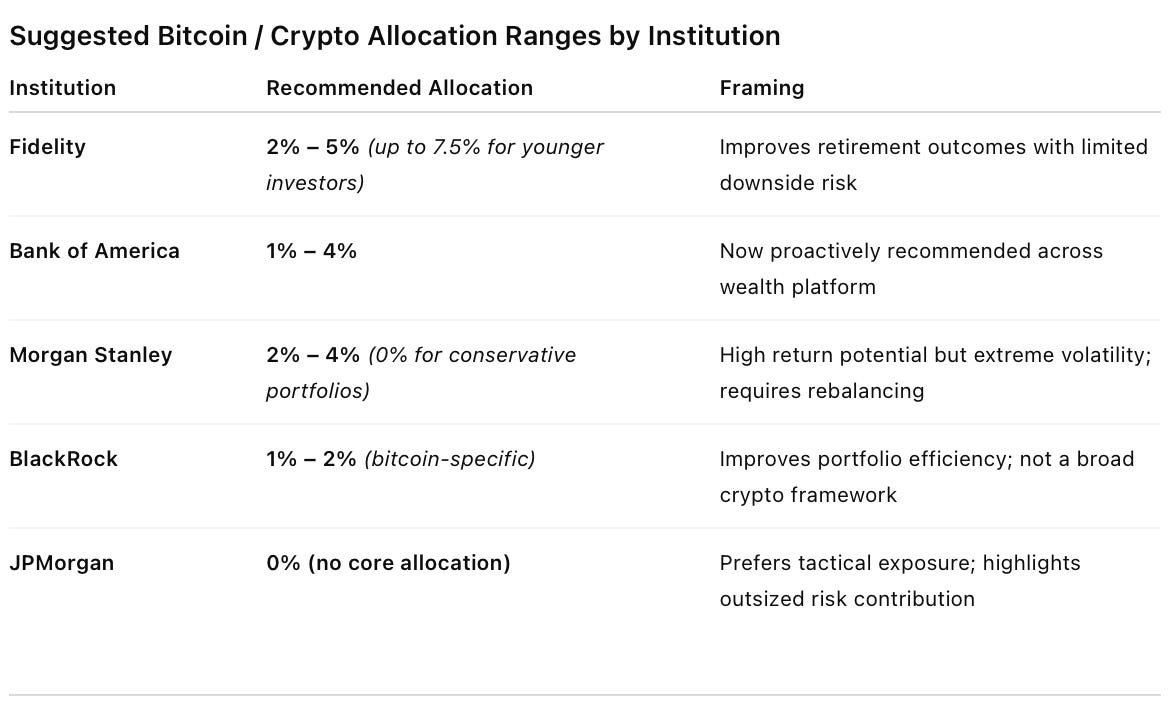
Sources: Bank of America; Fidelity; Morgan Stanley; J.P. Morgan Private Bank; BlackRock; Yahoo Finance
Unsurprisingly, JPMorgan — whose CEO has historically lambasted crypto — does not recommend it as a core portfolio allocation, noting that even a “moderate” position can contribute 2–3x its weight in risk.
Here’s the bank’s position, in plain terms:
Bitcoin doesn’t fit neatly into traditional portfolios. It offers upside and diversification but comes with high volatility and drawdown risk.
Not suitable as a core holding. May make sense only as a small, satellite allocation for aggressive or opportunistic investors.
Position sizing and risk management are critical. Returns can be large, but outcomes are highly uncertain.
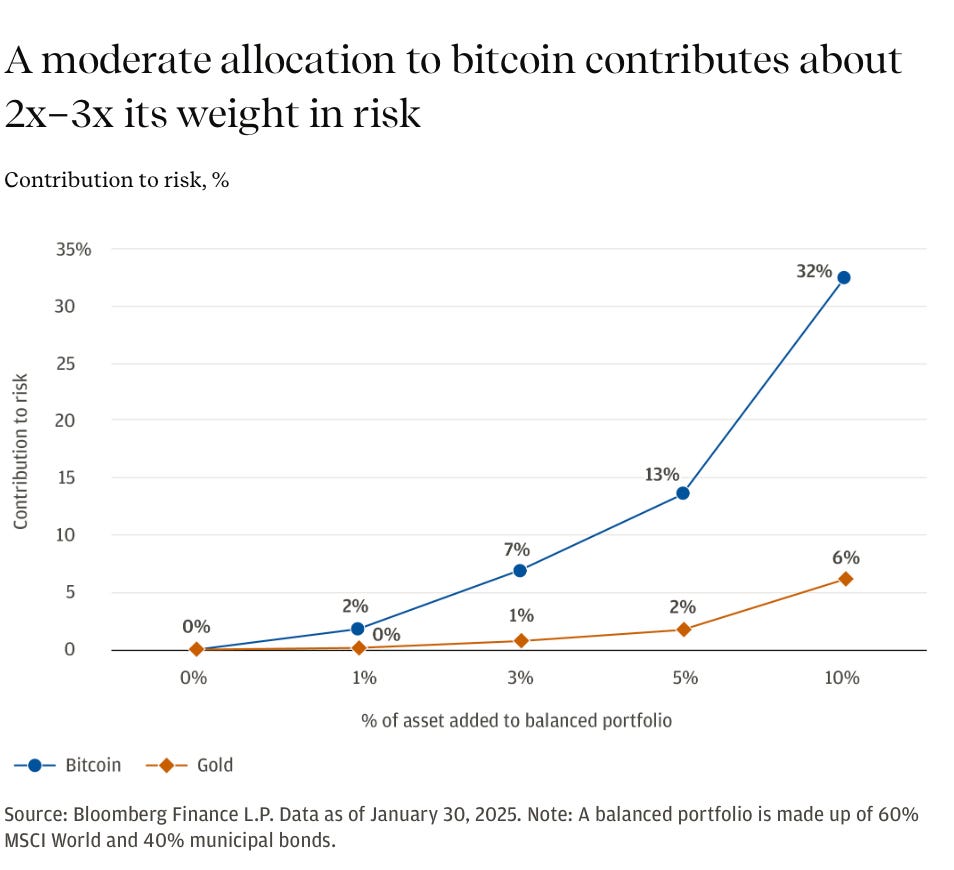
Source: JPMorgan
That volatility is an opportunity, as noted by Morgan Stanley. The bank, which says 4% allocation could be appropriate for certain investors, expects bitcoin to deliver strong compounding returns but with the risk that’s much higher than stocks. Here’s the bank:
The Global Investment Committee expects cryptocurrency to deliver strong compound returns of around 6% over a seven-year horizon, but with significant risk to investors: Crypto’s annualized volatility is about 55%—which is approximately four times that of the S&P 500 Index.
Bitcoin’s volatility has declined considerably from its early days, and the rise of ETFs has brought in a more stable base of investors. That should further solidify its role as an institutional asset. In a few years, even JPMorgan may change its tune.